
Built for every industry. Trusted by global brands bringing privacy, performance, and intelligence to the edge.
Contact Us
Sensory’s broad portfolio of voice, biometric, and sound identification SDKs gives product teams a single, flexible AI stack that fits everything from in-car systems to medical devices, PCs, and smart watches.
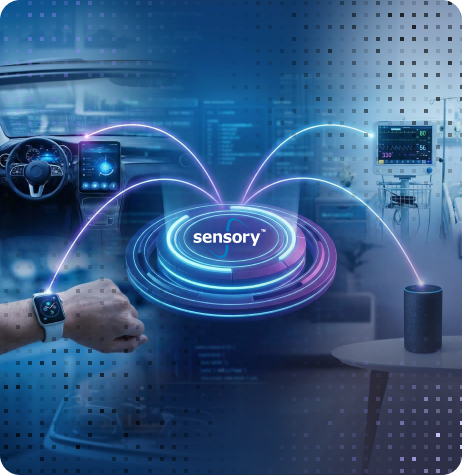
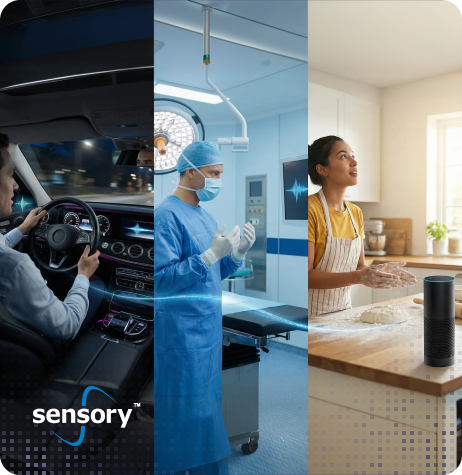
A modular, API-driven architecture that lets you mix, match, and scale the right capabilities for every device and market.
Step 1: Select the Core Capabilities
Product teams choose from wake word, command-and-control, speech-to-text, biometrics, and sound ID modules based on target use cases and user journeys.
Step 2: Configure Wake Words & Models
Using tools like VoiceHub, teams define custom wake words, intents, and grammars, adjust model sizes, and choose languages that fit memory budgets and UX goals.
Step 3: Integrate Across Platforms
SDKs and sample project code are available to support major operating systems and silicon platforms, allowing engineers to reuse core logic across microcontrollers, application processors, and cloud-connected devices.
Step 4: Connect to LLMs and Cloud Services
Sensory’s on-device components handle wake word, local recognition, and biometrics, then hand off transcripts or intents to LLMs or domain services for richer conversational experiences when desired.
Step 5: Tune, Deploy, and Scale
Models and thresholds are tuned for accuracy, latency, and power, then deployed across product lines and regions with consistent APIs and configuration patterns.
This modular approach lets teams add or swap capabilities—like sound ID or biometrics—later without re-architecting their entire stack or changing platforms.
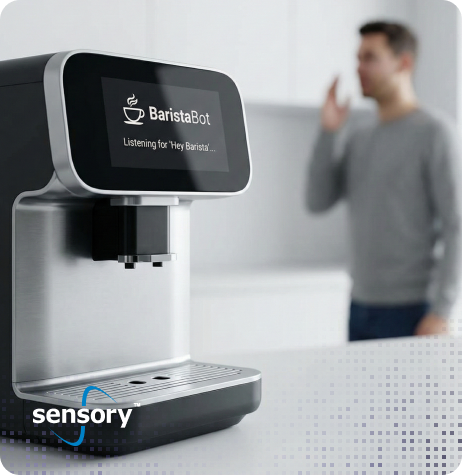
Faster launches, less integration risk, and a clear path from today’s features to tomorrow’s AI roadmap.
Real results. Real stories. Powered by Sensory AI.

“Sensory’s technology has exceeded our high standards for accuracy, speed, and efficiency. By enabling hands-free control of key functions through voice commands, we’re boosting productivity and streamlining workflows for retail staff. This allows our frontline workers to focus on what matters most – delivering exceptional customer service.”

“By combining MediaTek’s expertise in generative AI technology with Sensory’s strengths in on-device voice AI, the collective efforts of our companies enable significant strides in providing next-level entertainment and security in vehicles powered by MediaTek Dimensity Auto.”

“Sensory’s TrulyHandsfree technology is a key component in making the Piqo not just compact and powerful, but also incredibly user-friendly. This partnership enhances our ability to provide unmatched value and safety to our customers.”

“The smartest TV ever deserves the smartest approach to privacy. With Telly’s use of Sensory’s on-device speech-to-text and voice technologies, we are able to bring extremely fast, low-latency voice commands to the living room.”

“Zoom is passionate about making collaboration easier, but we always put our customer’s privacy and security front and center. Sensory’s technology checked all the boxes for us: accurate, fast and private…”
Interact with real-time AI demos and find out what sets us apart.
Everything you need to know about Sensory’s portfolio and deployment flexibility.
Sensory provides wake word, command-and-control, embedded STT, face and voice biometrics, and environmental sound identification SDKs for a wide range of devices.
Developers can create many types of branded or user-defined wake words and flexible command sets in multiple languages, each with configurable tuning for accuracy, memory, and power.
Sensory supports dozens of languages, major operating systems and silicon architectures, from mobile and desktop to embedded MCUs and DSPs.
Yes. The same APIs and models can be deployed across many SKUs and products, with configuration options that adapt to memory, CPU, and connectivity constraints.
On-device wake word, speech, and biometrics modules feed text or intents into LLM-based services, enabling responsive, natural VoiceChat-style experiences without sacrificing privacy or power efficiency.


