
Built for every industry. Trusted by global brands bringing privacy, performance, and intelligence to the edge.
Contact Us
Sensory’s advanced neural network models deliver state-of-the-art accuracy in 35+ languages while keeping power draw so low that always-on listening is practical on everything from MCUs to premium SoCs.
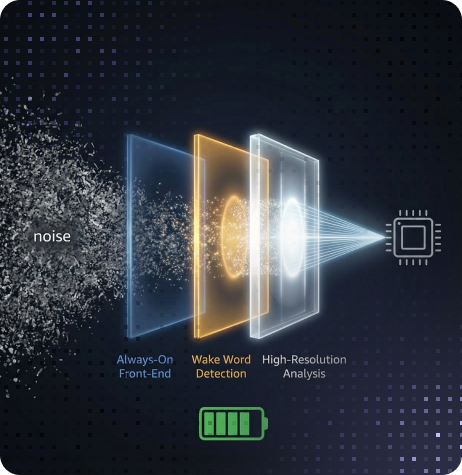
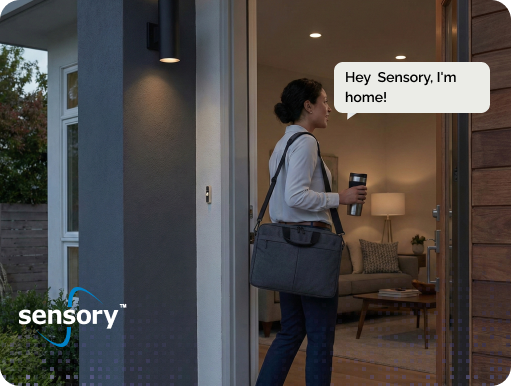
A layered, hardware-aware architecture that listens continuously, responds instantly, and conserves energy at every step.
Step 1: Always-On Front-End Listening
Low-power front-end components and signal processing continuously monitor audio for speech or wake word activity using highly efficient detection algorithms.
Step 2: Lightweight Wake Word & Event Detection
Sensory Wakeword and event models run in an ultra-low-power mode, filtering out background noise while only escalating likely triggers.
Step 3: High-Resolution Neural Network Analysis
When a trigger is detected, higher-resolution neural network models analyze the audio in detail, leveraging advanced features to improve recognition accuracy in challenging conditions.
Step 4: Optimized Embedded Inference
Models are quantized and architected for embedded CPUs, DSPs, and NPUs, minimizing memory requirements, compute cycles, and power consumption without compromising performance.
Step 5: Fast, Local Response
Recognized commands, intents, or events are passed directly to the host application, enabling immediate, on-device actions without cloud round trips or added energy cost.
This architecture keeps power consumption extremely low while still delivering fast, accurate responses, so products can stay always-on without sacrificing battery life or user experience.
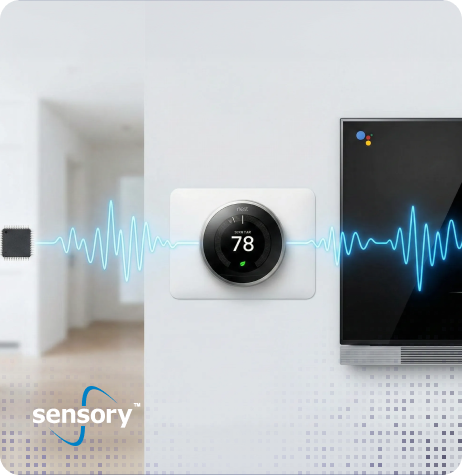
Fewer errors, longer battery life, and more design flexibility for your next-generation devices.
See how leading brands use Sensory’s on-device AI to deliver faster, safer, and more intuitive user experiences at scale.

“Sensory’s technology has exceeded our high standards for accuracy, speed, and efficiency. By enabling hands-free control of key functions through voice commands, we’re boosting productivity and streamlining workflows for retail staff. This allows our frontline workers to focus on what matters most – delivering exceptional customer service.”

“By combining MediaTek’s expertise in generative AI technology with Sensory’s strengths in on-device voice AI, the collective efforts of our companies enable significant strides in providing next-level entertainment and security in vehicles powered by MediaTek Dimensity Auto.”

“Sensory’s TrulyHandsfree technology is a key component in making the Piqo not just compact and powerful, but also incredibly user-friendly. This partnership enhances our ability to provide unmatched value and safety to our customers.”

“The smartest TV ever deserves the smartest approach to privacy. With Telly’s use of Sensory’s on-device speech-to-text and voice technologies, we are able to bring extremely fast, low-latency voice commands to the living room.”

“Zoom is passionate about making collaboration easier, but we always put our customer’s privacy and security front and center. Sensory’s technology checked all the boxes for us: accurate, fast and private…”
Interact with real-time AI demos and find out what sets us apart.
Everything you need to know about Sensory’s accuracy and power profile.
Sensory’s embedded speech technologies support more than 35 languages and many dialects, with models tuned for local accents and real-world usage.
Yes. Low-power detectors and highly efficient wake word models allow always-listening configurations that can draw as little as fractional milliamps, ideal for wearables and IoT.
Sensory’s technologies are designed to recognize speech reliably even in high-noise and far-field conditions, including environments with near 0 dB SNR.
Sensory runs on a wide range of MCUs, DSPs, NPUs, and application processors from partners such as Arm, Qualcomm, Cirrus, Alif, and others, covering everything from MCUs to premium SoCs.
Sensory consistently demonstrates higher accuracy, fewer false triggers, and lower power consumption than typical embedded alternatives, while keeping models compact enough for constrained devices. Head-to-head data tells the story: Sensory's 1MB wake word model outperformed Amazon's edge model across every noise condition tested by independent lab Vocalize.ai, and Sensory's STT edge model achieved 4.7% WER — beating both Amazon's cloud and Picovoice's on-device solutions.


