Built for every industry. Trusted by global brands bringing privacy, performance, and intelligence to the edge.
Contact Us
Ultra-low power, on-device wake word detection designed for constrained hardware and real-world environments.
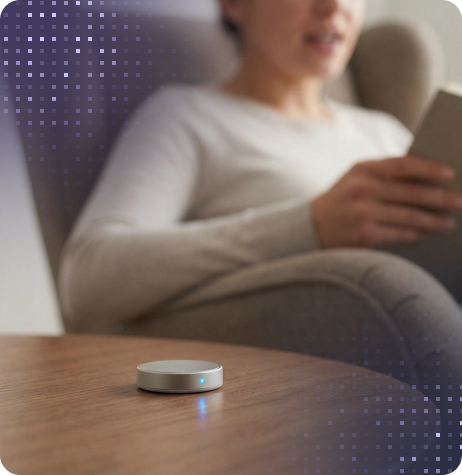



















































At the core of Sensory’s wake word technology is a focus on small, efficient models that deliver reliable detection in real-world conditions. Sensory Wake Words are designed to scale across hardware environments, from ultra-constrained, bare-metal chips to OS-based systems and hybrid architectures that balance power and performance.
These compact wake words act as the entry point for richer voice interactions and can be paired with higher-level Sensory technologies for commands, speech-to-text, or biometric verification, depending on product needs.
Sensory Wake Word also serves as the foundation for more advanced options like Smart Wake Words, Secure (Biometric) Wake Words, and Personalized Wake Words, allowing manufacturers to add intelligence, security, or personalization without changing the core architecture.
All audio processing stays on the device, ensuring instant response times, consistent performance, and complete data privacy.
Wake Word Selection Checklist
Designed for reliability, efficiency, and embedded performance.

Runs on devices with as little as ~15-20KB RAM and minimal CPU usage.

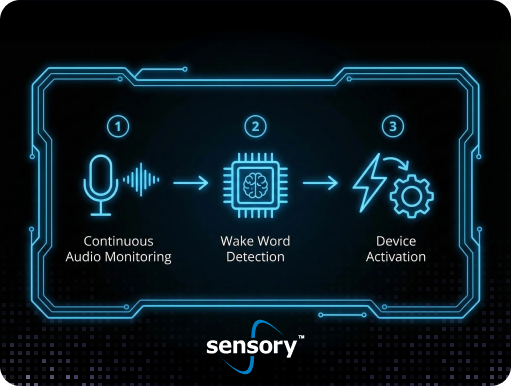
Continuous listening without streaming audio or sending data to the cloud.

Maintains accuracy across far-field, background noise, and real-world conditions.

Software-only wake word models that run consistently across MCUs, DSPs, and major OSs, so you are never locked into a single chip vendor and can reuse the same voice experience as hardware roadmaps evolve.
Wake words can be trained, tested, and deployed using Sensory VoiceHub; fully automated.
Simple architecture designed for constrained devices OR A lightweight architecture engineered for efficiency and reliability.
Wake word detection runs independently of cloud connectivity and does not store or transmit audio.

| Tier 1 ICs | Chip P/N | Core | VoiceHub Support |
|---|---|---|---|
| Ambiq Micro | Apollo3 Blue Apollo3 Plus | 32-bit ARM Cortex-M4F | Yes, Multiword |
| Ambiq Micro | Apollo 4 Apollo 4 Blue | 32-bit ARM Cortex-M4F | Yes, Multiword |
| Ambiq Micro | Apollo 5 | CM55 | Yes, Multiword |
| Amlogic | S905X4 | Cadenca Tensilica HiFi 4 config Amlogic_v3_win32_redist.tgz. | Yes, Multiword |
| Analog Devices | ADADN8080 (in limited release by ADI) rebranded as ADAU1472 target soundbars dcx | Cadenca Tensilica HiFi 4 | Yes, Multiword |
| Analog Devices | ADAU1860 (smartglasses chip for India/Asia?) | HiFi 3Z | Yes, Multiword |
| Cirrus | CS48L32 (Cooke) | Halo | Yes, Multiword |
| Cirrus | CS48LV40F (Wright) | Halo ARM A53 | Yes, Multiword |
| Cirrus | CS47L66 (Shelley) | Halo | Yes, Multiword |
| Cypress Semi/Infineon | PSoC6 | CM4 | Yes, Multiword |
| Espressif | ESP32 | Xtensa LX6 (not LX7) | Yes, Multiword |
| Fortemedia | iM401 | Hifi | |
| Fortemedia | iM501 | Hifi Mini | Yes (single phrase) |
| General Plus | GPM43/47 | Cortex M4F @193Mhz, 128/256KB core memory 32MB DRAM | Yes, Multiword |
| General Plus | GPCM300A | CM0 | Yes, Multiword |
| General Plus | GD32F450 - CM4 GD32W515 - CM33 | CM4/33 | Yes, Multiword |
| Realtek | Realtek RTL8720E | CM55 | Yes, Multiword |
| Knowles | Athletico IA8508 | Four Processor Cores:
| |
| Knowles | Chelsea IA8201 | HiFi3 | Yes, Multiword |
| Knowles | Shakira IA611 top port mic | Custom Tensilica (HiFi 3) | Yes, Multiword |
| Knowles | Shapiro IA610 bottom port mic | Custom Tensilica (HiFi 3) | Yes, Multiword |
| National Chip | National Chip GX8008C | HIFi 4 | Yes, Multiword |
| NXP | i.MX7D (done for Vocera) | 1 available ARM CM4 core (also 2 x A53 cores) | Yes, Multiword |
| NXP | LPC5411x (Niobe) | ARM CM4 | Yes, Multiword |
| NXP | RT600 | HiFi 4 (also has a Cortex-M33) | Yes, Multiword |
| NXP | RT10xx | ARM CM7 | Yes, Multiword |
| NXP | RT117x | ARM CM7 | Yes, Multiword |
| Infineon | Infineon CYT3BB5CEBQ0AESGS Infineon CYT4BF8CEDQ0AESGS Infineon CYT4BF8CEDQ0AESGS (hard float) | ARM CM7 | Yes, Multiword |
| Qualcomm | Hexagon sDSP/LPI cDSP mDSP | v55 v66 | Yes, Multiword |
| Qualcomm | Slate/QCC1100 | HiFi 5 | Yes, Multiword |
| Qualcomm | QCC51XX Series + QCC3095 (Not 1100/Slate) | Kalimba | Yes |
| Qualcomm/CSR | BC05 | Kalimba | |
| Qualcomm/CSR | 8670 | Kalimba | |
| Qualcomm/CSR | 8675 | Kalimba | |
| Realtek | ALC5677 | Hifi Mini | |
| Realtek | ALC5679 | Hifi Mini | |
| Realtek | ALC5680 | Hifi Mini | |
| Realtek | ALC5512 ALC5513 ALC5514 | Hifi Mini | |
| Realtek | ALC5520/1 | HiFi Fusion F1 | |
| Realtek | RTL8720E | CM7 | |
| Renesas/FDI | RA6 | CM4 | Yes, Multiword |
| Samsung | Exynos | HiFi5 | Yes, Multiword |
| Airoha | Airoha A1565 | HiFi 5/HiFi Mini | Yes, Multiword |
| Qualcomm | Qualcomm QCC5181 | Kalimba | Yes, Multiword |
| Silicon Labs | Series 1 Gecko family looks like: EFR32xG1x – CortexM4 based Series 2 Gecko family: EFR32xG2x – CortexM33 based | CM4, CM33 | Yes, Multiword |
| STMicro | STM32F4X STM32L4X STM32F7X STM32H7 STM32U5 | ARM CM4/7 | Yes, Multiword |
| TI | TMS320C6746 | C674x (TI Proprietary) | Yes, Multiword |
| TI | OMAP L138 (Freon) | C674x (TI Proprietary) | Yes, Multiword |
| TI | CM4-based MCUs (CC1352 800-900 MHz radio,CC322x WiFi) | Arm CM4 | Yes, Multiword |
| TI | CM55 | Arm CM33 | Yes, Multiword |
| TimesIntelli | AT1/8x | RISC-V | Yes, Multiword |
| XMOS | XVF 3100 XVF 3510 | xCORE-200 | Yes, Multiword |
| XMOS | xcore.ai | xcore.ai | Yes, Multiword |
| ARM | (core, not a chip) | Cortex-M0 | Yes |
| ARM | (core, not a chip) | Cortex-M4 | Yes |
| ARM | (core, not a chip) | Cortex-CM7 | Yes |
| ARM | (core, not a chip) | Cortex-CM33 | Yes |
| ARM | (core, not a chip) | Cortex-CM55 | Yes |
| ARM | (core, not a chip) | Cortex-CM85 | Yes |
| Cadence (need customer specific configuration file) | (core, not a chip) | Hifi Mini | Need to use generic pc 60/62w choice |
| Cadence (need customer specific configuration file) | (core, not a chip) | HiFi3 | Yes, Multiword |
| Cadence (need customer specific configuration file) | (core, not a chip) | HiFi3z rebuild from Fusion F1 | |
| Cadence (need customer specific configuration file) | (core, not a chip) | HiFi 4 | Yes, Multiword |
| Cadence (need customer specific configuration file) | (core, not a chip) | Fusion F1 | |
| Cadence (need customer specific configuration file) | (core, not a chip) | HiFi 5 | Yes, Multiword |
| Cadence (need customer specific configuration file) | LH7 | Yes, Multiword | |
| TimesIntelli | AT1/8x | RISC-V | Yes |
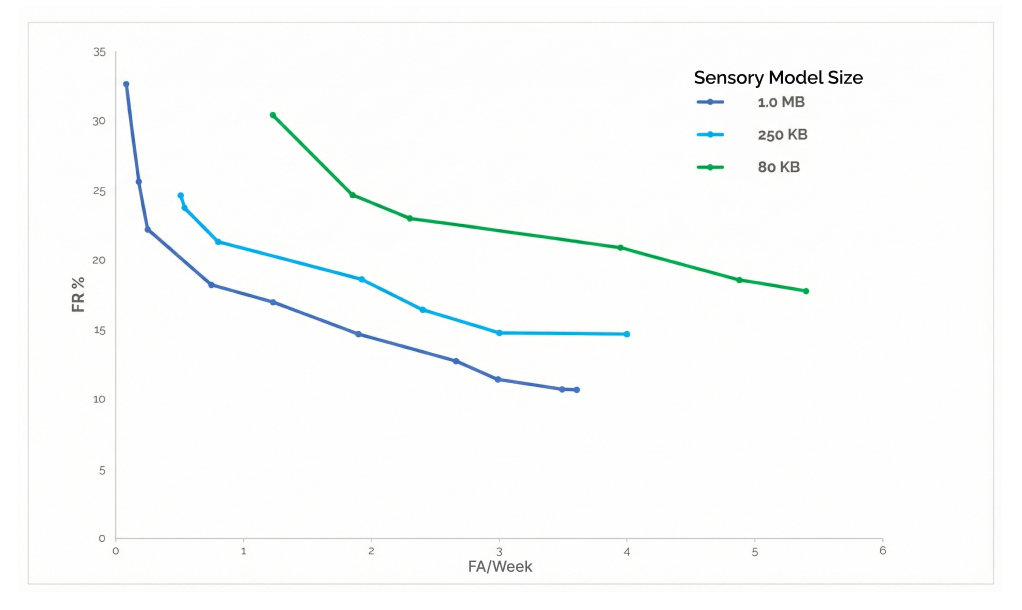
Accuracy can vary with vocabulary size, vocabulary words, grammar specifications, noise conditions, accents of users, distance from Mic to speaker, and technology used. The Sensory approach is best for rejecting the wrong words and performing well in higher noise or far field situations. Sample accuracy curve shows the key metrics of false accept (FA) and false reject (FR) at different model sizes.
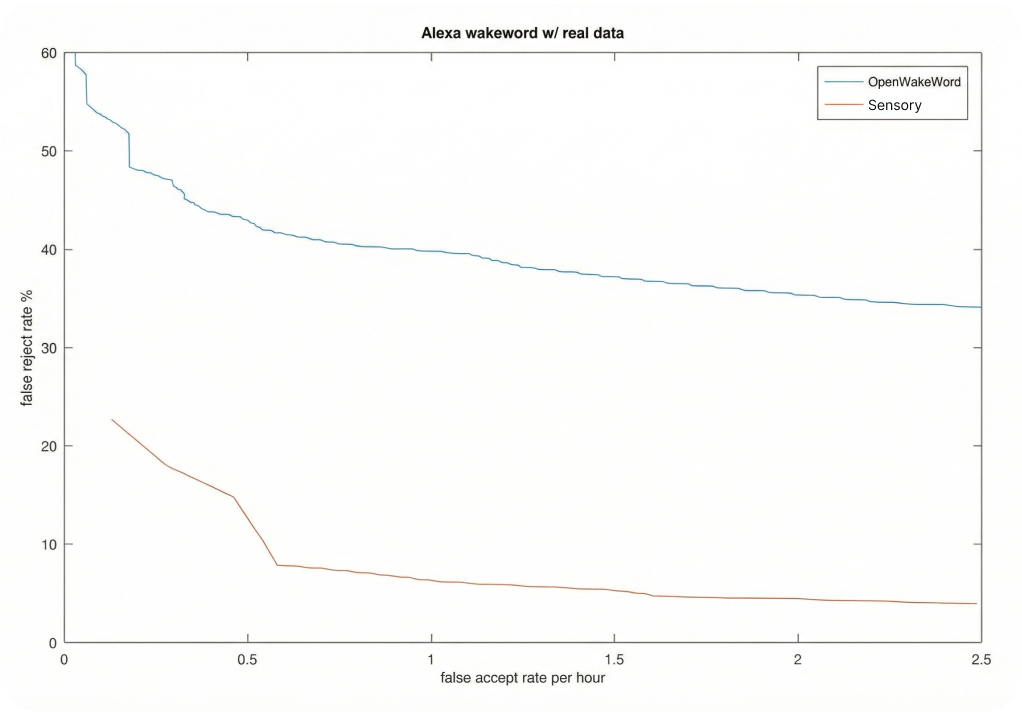
The chart shows the comparative performance of the Sensory vs OpenWakeWord for the “Alexa” trigger. Sensory offers the Alexa and Siri Wake Words tuned for many languages.
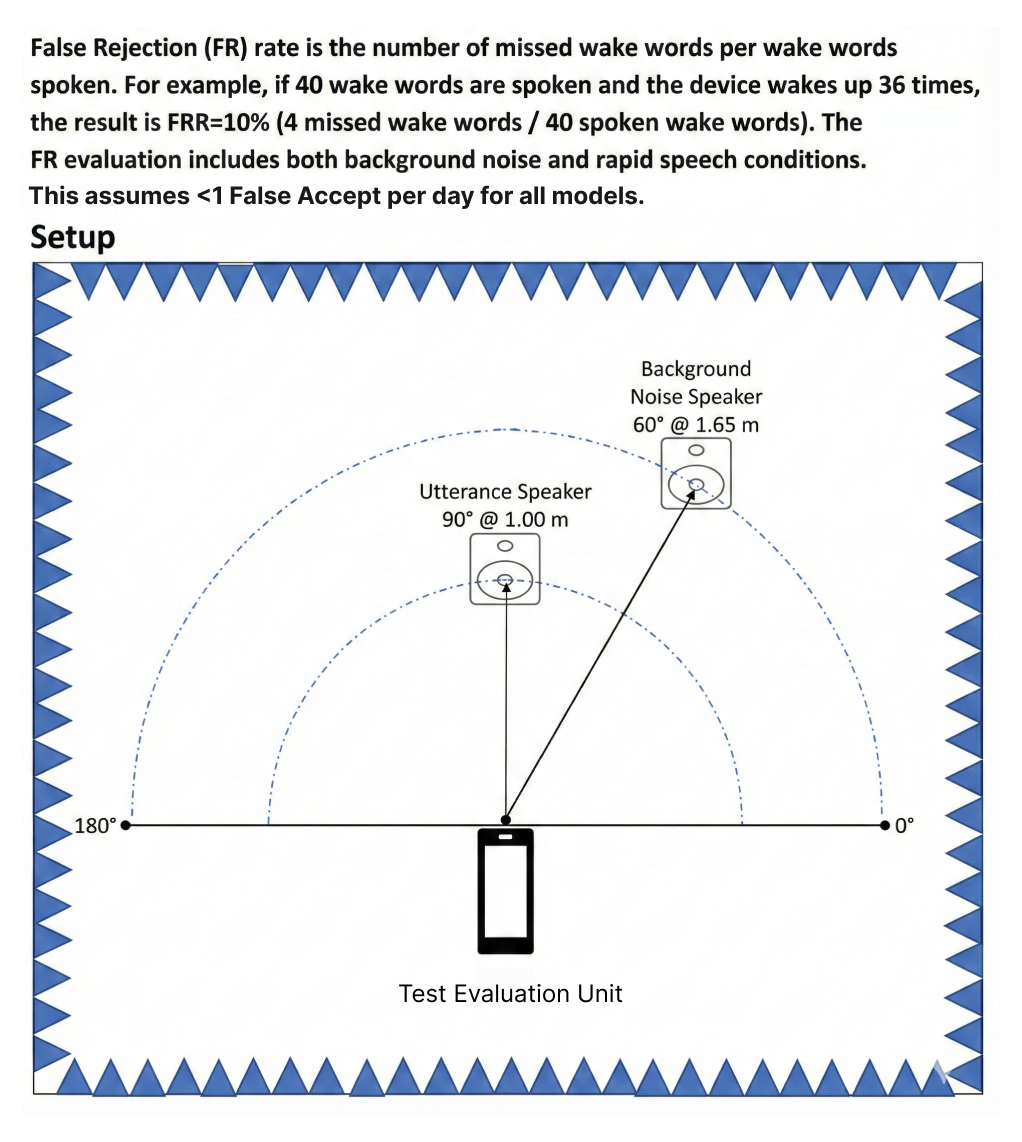
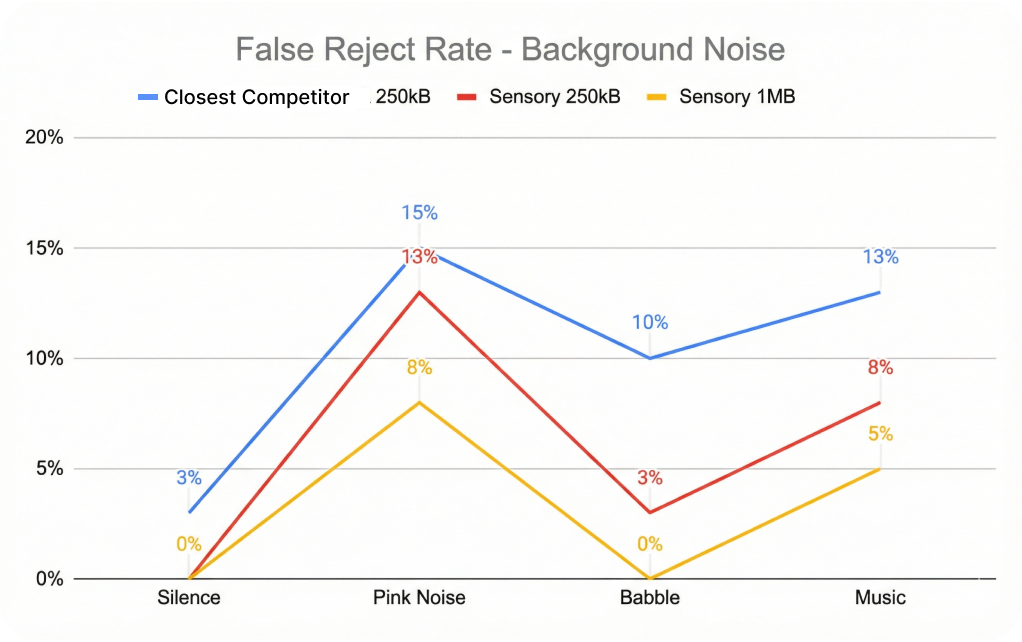
| Wake Word False Reject Rates in Noise | |||
|---|---|---|---|
| Noise Condition | Closest Competitor 250 KB |
Sensory 250KB |
Sensory 1MB |
| Silence | 3% | 0% | 0% |
| Pink Noise | 15% | 13% | 8% |
| Babble | 10% | 3% | 0% |
| Music | 13% | 8% | 5% |
| Typical Embedded Resource Requirements (High Efficiency Tensilica Hifi 4) | ||||
|---|---|---|---|---|
| Model Size & Type | Nominal MIPS | Peak MIPS | ROM (KB) | RAM (bytes SPP) |
| 80 KB Single Fixed Wake Word | 4.0 | 5.2 | 136 | 17.7 |
| 250 KB Singled Fixed Wake Word | 5.8 | 6.8 | 292 | 17.7 |
| 1 MB Single Fixed Wake Word | 13.8 | 14.9 | 1066 | 19.8 |
Sensory wake words can range from 20KB to 2MB these are examples from a specific wakeword phrase
See how leading brands use Sensory’s on-device AI to deliver faster, safer, and more intuitive user experiences at scale.
“Sensory’s technology has exceeded our high standards for accuracy, speed, and efficiency. By enabling hands-free control of key functions through voice commands, we’re boosting productivity and streamlining workflows for retail staff. This allows our frontline workers to focus on what matters most – delivering exceptional customer service.”

“By combining MediaTek’s expertise in generative AI technology with Sensory’s strengths in on-device voice AI, the collective efforts of our companies enable significant strides in providing next-level entertainment and security in vehicles powered by MediaTek Dimensity Auto.”
“Sensory’s TrulyHandsfree technology is a key component in making the Piqo not just compact and powerful, but also incredibly user-friendly. This partnership enhances our ability to provide unmatched value and safety to our customers.”

“The smartest TV ever deserves the smartest approach to privacy. With Telly’s use of Sensory’s on-device speech-to-text and voice technologies, we are able to bring extremely fast, low-latency voice commands to the living room.”
“Zoom is passionate about making collaboration easier, but we always put our customer’s privacy and security front and center. Sensory’s technology checked all the boxes for us: accurate, fast and private…”
Interact with real-time AI demos and find out what sets us apart.
Reliable wake word activation wherever low power and privacy matter most.
Everything You Need to Know
No. All processing runs fully on-device.
MCUs, DSPs, and embedded processors including ARM Cortex-M and Cadence HiFi platforms.
Manufacturers can deploy custom phrases trained through VoiceHub.
Yes. The models are designed specifically for ultra-low power operation.
Yes. Wake words often act as the entry point to commands, STT, or biometrics.