
Built for every industry. Trusted by global brands bringing privacy, performance, and intelligence to the edge.
Contact Us
Sensory’s ultra-compact, highly accurate voice and speech models run efficiently on existing or lower cost edge hardware and send text instead of audio, cutting costs while improving user experience and privacy.

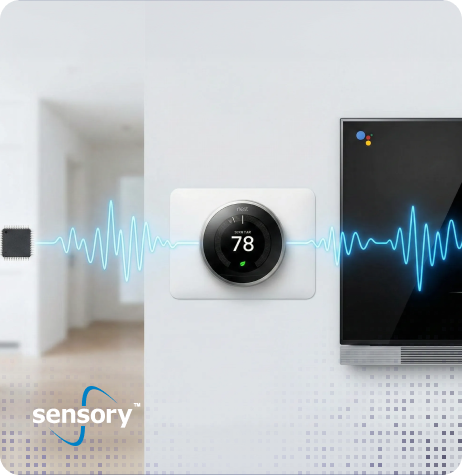
A lean, edge-first architecture that shrinks hardware, bandwidth, and cloud bills while preserving recognition quality.
Step 1: On-Device Wake Word & Voice Activity Detection
Highly optimized wake word and voice activity detection (VAD) models run at ultra-low power, eliminating continuous audio streaming to the cloud and reducing both bandwidth and compute usage.
Step 2: Compact, Highly Accurate STT on Device
Sensory Speech-to-Text converts voice locally to text, using models that are orders of magnitude smaller than typical cloud engines yet maintain competitive accuracy.
Step 3: Text Handoff to LLMs or Applications
Only transcribed text (not the actual voice or background sounds from the home) is sent to cloud LLMs or local SLMs, cutting payload sizes dramatically while enabling rich conversational and task-completion experiences and maintaining biometric privacy.
Step 4: Hardware-Aware Optimization
Models are tuned to leverage available accelerators and cores, minimizing MIPS and memory so products can use lower-cost processors without compromising performance.
Step 5: Fast, Local Decisions
Where possible, intents and commands are resolved entirely on device, eliminating round trips, lowering latency, and further reducing reliance on metered cloud services.
This hybrid architecture allows for efficient, on-device models so products gain a durable cost advantage: smaller chips, lighter data plans, and fewer cloud cycles while still delivering fast, accurate, and private voice experiences.
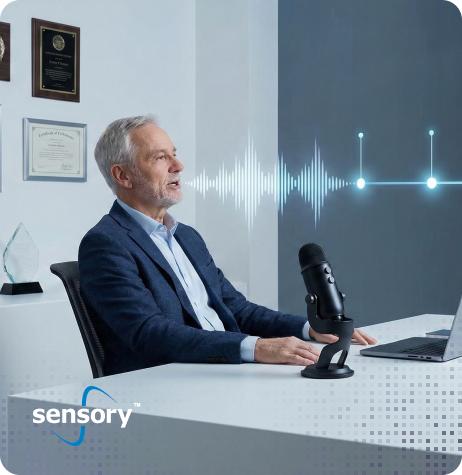

Lower total cost of ownership, better experiences, and more competitive products.
Real results. Real stories. Powered by Sensory AI.

“By combining MediaTek’s expertise in generative AI technology with Sensory’s strengths in on-device voice AI, the collective efforts of our companies enable significant strides in providing next-level entertainment and security in vehicles powered by MediaTek Dimensity Auto.”

“The smartest TV ever deserves the smartest approach to privacy. With Telly’s use of Sensory’s on-device speech-to-text and voice technologies, we are able to bring extremely fast, low-latency voice commands to the living room.”

“Sensory’s technology has exceeded our high standards for accuracy, speed, and efficiency. By enabling hands-free control of key functions through voice commands, we’re boosting productivity and streamlining workflows for retail staff. This allows our frontline workers to focus on what matters most – delivering exceptional customer service.”

“Sensory’s TrulyHandsfree technology is a key component in making the Piqo not just compact and powerful, but also incredibly user-friendly. This partnership enhances our ability to provide unmatched value and safety to our customers.”

“Zoom is passionate about making collaboration easier, but we always put our customer’s privacy and security front and center. Sensory’s technology checked all the boxes for us: accurate, fast and private…”
Interact with real-time AI demos and find out what sets us apart.
Everything you need to know about Sensory’s cost and accuracy advantages.
By running STT on device and sending only text to the cloud, Sensory can cut bandwidth usage by more than 90%, which directly reduces recurring cloud processing expenses.
Yes. Sensory’s engines offer an industry-leading accuracy-to-size ratio and have been optimized to run efficiently on constrained CPUs, MCUs and DSPs while maintaining high recognition quality.
Lower BOM costs, reduced bandwidth and cloud fees, and fewer support incidents combine to materially lower TCO across large device fleets over their full lifecycle. It also creates a predictable one-time expense that aligns with product distribution instead of requiring an unpredictable future operating cost for subscriptions to cloud services.
Sensory is designed to front-end state-of-the-art LLMs by supplying clean text, allowing you to deliver advanced assistants with significantly lower bandwidth and compute requirements than streaming raw audio.
Sensory typically delivers smaller models, lower power requirements, and higher accuracy than competing embedded engines, enabling superior performance on lower-cost hardware. In head-to-head STT benchmarking, Sensory's Large edge model achieved 4.7% WER versus competitors 10.0% — and even Sensory's Small model (24 MB) outperformed similar products at a fraction of the model size.


