
Built for every industry. Trusted by global brands bringing privacy, performance, and intelligence to the edge.
Contact Us
Give embodied robots natural voice, sound awareness, and biometrics that run fully on-device so they can interact safely, privately, and intelligently in the real world.
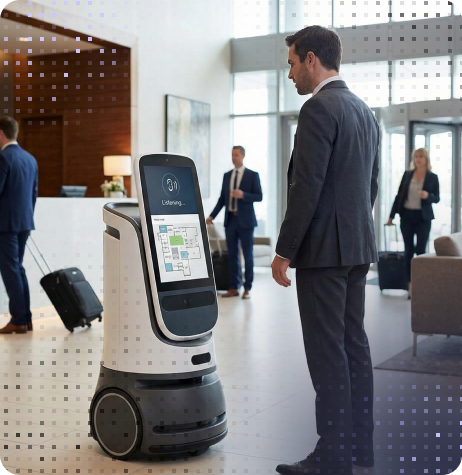



















































Embodied robots need more than motion. They need multimodal perception and communication that works reliably in noisy, dynamic environments. Sensory’s embedded AI platform gives embodied robots custom wake words, conversational speech recognition, sound awareness, and biometrics, all processed locally for low latency and strong privacy.
Using Sensory’s suite of AI voice and vision technologies, robotics teams can build agents that understand commands, react to events, and recognize users without relying on the cloud. On-device language models and hybrid options allow robots to combine fast, local understanding with selective, controlled access to larger LLMs when needed.
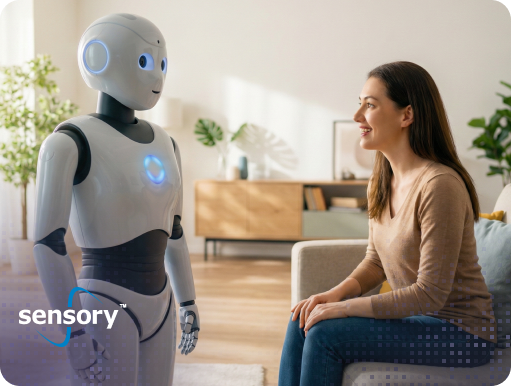
On-device voice, sound, and biometric AI engineered for embodied robots that must be responsive, power-efficient, and trustworthy.
Branded or personal hotwords that wake robots instantly.
On-device STT and language models for natural voice, with optional cloud LLMs.
SoundID for alarms, calls for help, glass breaking, and mechanical issues.
User recognition and access control without passwords or phones.
Compact models for CPUs, NPUs, and MCUs in mobile, power-limited robots.
On-device audio and biometrics for private, reliable operation anywhere.
Trusted, production-proven embedded AI that helps embodied robots listen, understand, and respond without giving up privacy, performance, or control.
Powers robots like ElliQ for wake words, personalization, and ambient awareness.
Voice, sound, and biometrics delivered in one integrated SDK.
Local inference so robots react in real time, even without connectivity.
Branded, domain-specific phrases tailored to each robot.
On-device perception that slots into embodied LLM planning and dialog.
Sensory supports social, service, and industrial robots operating in homes, workplaces, and public spaces.
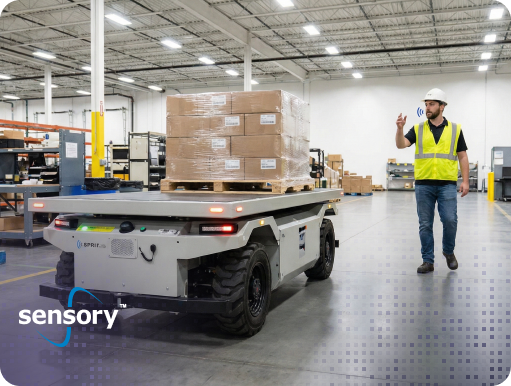
See how leading brands use Sensory’s on-device AI to deliver faster, safer, and more intuitive user experiences at scale.
“Sensory’s technology has exceeded our high standards for accuracy, speed, and efficiency. By enabling hands-free control of key functions through voice commands, we’re boosting productivity and streamlining workflows for retail staff. This allows our frontline workers to focus on what matters most – delivering exceptional customer service.”

“By combining MediaTek’s expertise in generative AI technology with Sensory’s strengths in on-device voice AI, the collective efforts of our companies enable significant strides in providing next-level entertainment and security in vehicles powered by MediaTek Dimensity Auto.”
“Sensory’s TrulyHandsfree technology is a key component in making the Piqo not just compact and powerful, but also incredibly user-friendly. This partnership enhances our ability to provide unmatched value and safety to our customers.”

“The smartest TV ever deserves the smartest approach to privacy. With Telly’s use of Sensory’s on-device speech-to-text and voice technologies, we are able to bring extremely fast, low-latency voice commands to the living room.”
“Zoom is passionate about making collaboration easier, but we always put our customer’s privacy and security front and center. Sensory’s technology checked all the boxes for us: accurate, fast and private…”
Interact with real-time AI demos and find out what sets us apart.
Everything you need to know about Sensory for embodied robots
Yes. Sensory’s wake words, STT, NLU, SoundID, and biometrics are designed to run entirely on-device, so robots can respond instantly and remain operational even when offline.
Sensory uses compact, efficient models optimized for CPUs, NPUs, and microcontrollers, enabling always-listening wake words and speech understanding within tight power and memory budgets.
Yes. Sensory Custom Wake Word and Sensory Personalized Wake Word allow robots to respond to unique brand phrases or user-defined hotwords, improving engagement and reducing false activations.
Sensory SoundID lets robots detect and classify key sounds such as alarms, glass breaking, distress calls, or mechanical anomalies, helping them act as more aware, safety-conscious agents in homes and workplaces.
Sensory provides C/C++, Android, Linux, and embedded integrations that fit into common robotics and edge AI stacks, and its STT and NLU outputs can feed directly into your existing planning, control, or LLM-based dialog layers.


