
Built for every industry. Trusted by global brands bringing privacy, performance, and intelligence to the edge.
Contact Us
Increase patient privacy, reduce clinician burden, and enable hands-free control with on-device voice, sound, and biometric AI built for regulated healthcare environments.









Healthcare technology must balance safety, privacy, and usability, all under intense time pressure and strict regulations. Sensory’s embedded AI platform helps device makers and healthcare providers deliver natural voice interfaces and secure authentication without sending private audio data or biometrics to the cloud.
Using Sensory Micro Wake Words, Key Word Spotting, Custom Grammar, Phrase Spotted Commands, Speech to Text, and face and voice biometrics, Sensory enables voice-driven control of medical devices, safer access to sensitive data, and more accessible patient experiences. Hybrid options with Sensory AI Speech-to-Text and on-device language models let you keep Protected Health Information (PHI) on the device while selectively connecting to private cloud or EHR systems for complex queries and documentation.

On-device voice, sound, and biometric AI built to protect PHI, support sterile workflows, and keep clinicians focused on patient care.
Voice and biometrics stay on-device, reducing PHI exposure and easing compliance.
Sterile, touchless control that works even in noisy ERs, ORs, and ICUs.
Domain vocabularies and on-device or hybrid on-device/secure-cloud STT for notes, orders, and control.
Exact-phrase recognition for protocol steps, settings, and device actions.
Fast, convenient biometric authentication for staff and patients—no passwords or badges.
Models handle busy, echo-prone clinical spaces without missing hotwords or commands.
On-device sound models detect coughing and snoring events in hospitals and home-care environments, supporting remote monitoring, sleep health insights, and early escalation without streaming raw audio.
Compact, low-power models scale from handhelds to bedside and home-health systems.
Sensory combines deep expertise in embedded AI with a strong track record in regulated, high-stakes use cases like banking, medical, and enterprise security.
Local processing by design for PHI, regulated environments, and offline workflows.
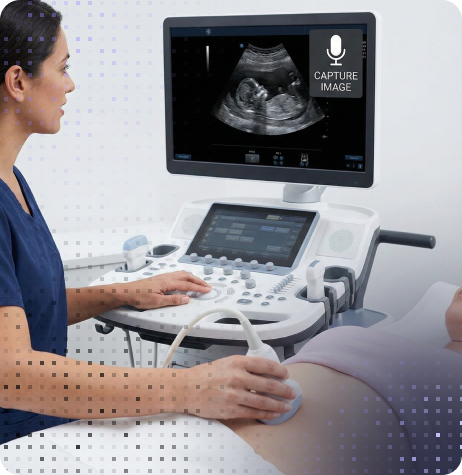
Powers Ultrasound Voice Assist and elder-care companions like ElliQ.
Face and speaker verification include liveness and anti-spoofing for safer access.
Tailored hotwords and terminology for each device, brand, and workflow.
Wake words, STT, and biometrics integrate with Sensory language models and external LLMs.
Sensory supports a wide range of clinical and patient-facing scenarios.


See how leading brands use Sensory’s on-device AI to deliver faster, safer, and more intuitive user experiences at scale.

“Sensory’s technology has exceeded our high standards for accuracy, speed, and efficiency. By enabling hands-free control of key functions through voice commands, we’re boosting productivity and streamlining workflows for retail staff. This allows our frontline workers to focus on what matters most – delivering exceptional customer service.”

“By combining MediaTek’s expertise in generative AI technology with Sensory’s strengths in on-device voice AI, the collective efforts of our companies enable significant strides in providing next-level entertainment and security in vehicles powered by MediaTek Dimensity Auto.”

“Sensory’s TrulyHandsfree technology is a key component in making the Piqo not just compact and powerful, but also incredibly user-friendly. This partnership enhances our ability to provide unmatched value and safety to our customers.”

“The smartest TV ever deserves the smartest approach to privacy. With Telly’s use of Sensory’s on-device speech-to-text and voice technologies, we are able to bring extremely fast, low-latency voice commands to the living room.”

“Zoom is passionate about making collaboration easier, but we always put our customer’s privacy and security front and center. Sensory’s technology checked all the boxes for us: accurate, fast and private…”
Interact with real-time AI demos and find out what sets us apart.
Everything You Need to Know
Sensory’s on-device approach helps healthcare organizations meet HIPAA and similar regulatory requirements because raw audio and biometrics do not need to leave the device. Compliance still depends on your full system design, storage, and integration practices.
On-device wake words and commands let clinicians control equipment without touch, reducing contamination risks and allowing them to maintain focus on the patient. Low-latency processing ensures commands execute quickly even without a network connection.
Sensory’s wake word and speech engines are trained and tuned for challenging acoustic environments, with noise-robust front-ends that distinguish commands from background chatter and alarms. This helps reduce false activations and missed commands in real-world conditions.
Sensory’s models are optimized for a range of embedded processors, microcontrollers, and application processors, enabling deployment in handheld devices, carts, consoles, and home-health equipment. Teams can choose ultra-compact footprints for low-power devices or larger models for richer vocabularies and languages.
Yes. Sensory Face Verification, combined with Sensory Text-Independent or Text-Dependent Speaker Verification, supports fusing face and voice biometrics so devices can authenticate with either modality alone or require both for higher assurance. This multi-factor biometric approach is especially valuable for access to sensitive records, controlled substances, or high-risk systems.


