
Built for every industry. Trusted by global brands bringing privacy, performance, and intelligence to the edge.
Contact Us
Combine Large Language Models (LLMs) with Sensory’s on-device wake words, speech-to-text (STT), and natural language understanding (NLU) to build fast, private, and branded voice agents that users can trust.

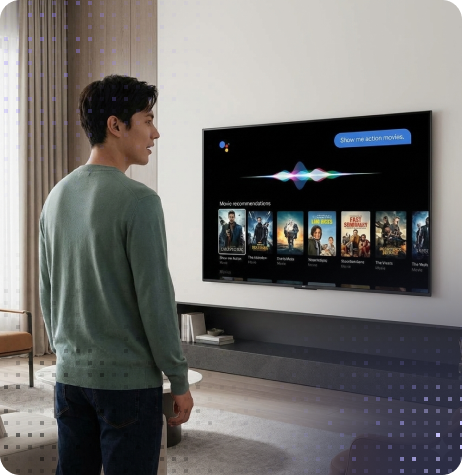



















































LLM-powered voice assistants are only as good as their front end: activation, transcription, and conversation flow must feel instant and seamless, or users drop off. Sensory’s embedded AI technology stack provides low-power wake words, on-device speech-to-text, and lightweight language models that act as a smart gateway between users and your LLM.
With Sensory Micro Wake Words, Word Spotted Commands, Custom Grammar, Speech-to-Text, and on-device Micro and Small Language Models, product teams can build voice experiences where the user’s audio stays local and only the clear, intent-ready text or structured requests reach the LLM. Hybrid options and external LLMs let you route each part of the workload (wake word, verification, STT, NLU, and generative responses) to the edge or cloud for the best mix of privacy, cost, and performance.
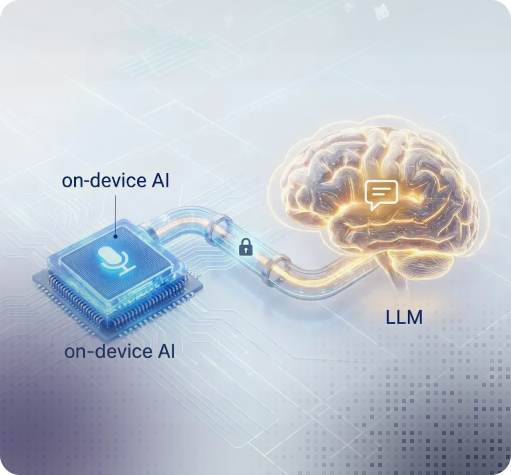
On-device AI that makes LLM voice experiences faster, cheaper, and more private.
On-device STT acts as a high-accuracy gateway to LLMs, cutting cost and latency while keeping voice data local.
Wake word, STT, NLU, and biometrics run at the edge, so assistants still wake, listen, and respond even when networks are weak or offline.
Models are tuned for far-field noise, accents, and everyday environments, reducing false wakes and missed triggers.
VoiceHub’s generative AI tools help design intents and grammars in hours instead of weeks.
Wake words, STT, and biometrics ship in over two billion products, hardening the LLM voice stack.
An embedded AI foundation built for LLM-era assistants.
On-device STT filters and compresses what reaches the model.
Low-latency wake, listen, and response flows.
Raw audio and biometrics can stay on device.
Assistants remain useful with limited connectivity.
Trusted across billions of consumer and enterprise devices.
Sensory powers LLM-based voice experiences across consumer, automotive, enterprise, and healthcare applications.
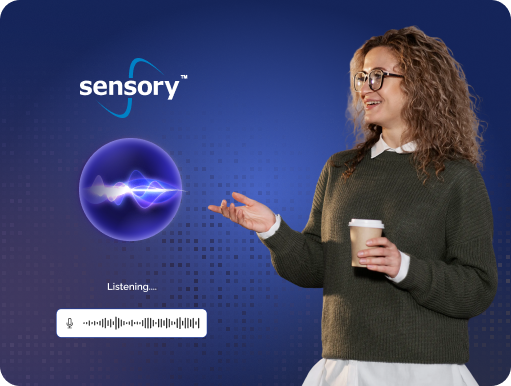
See how leading brands use Sensory’s on-device AI to deliver faster, safer, and more intuitive user experiences at scale.
“Sensory’s technology has exceeded our high standards for accuracy, speed, and efficiency. By enabling hands-free control of key functions through voice commands, we’re boosting productivity and streamlining workflows for retail staff. This allows our frontline workers to focus on what matters most – delivering exceptional customer service.”

“By combining MediaTek’s expertise in generative AI technology with Sensory’s strengths in on-device voice AI, the collective efforts of our companies enable significant strides in providing next-level entertainment and security in vehicles powered by MediaTek Dimensity Auto.”
“Sensory’s TrulyHandsfree technology is a key component in making the Piqo not just compact and powerful, but also incredibly user-friendly. This partnership enhances our ability to provide unmatched value and safety to our customers.”

“The smartest TV ever deserves the smartest approach to privacy. With Telly’s use of Sensory’s on-device speech-to-text and voice technologies, we are able to bring extremely fast, low-latency voice commands to the living room.”
“Zoom is passionate about making collaboration easier, but we always put our customer’s privacy and security front and center. Sensory’s technology checked all the boxes for us: accurate, fast and private…”
Interact with real-time AI demos and find out what sets us apart.
Everything you need to know about Sensory for LLM voice agents
Yes. Without a wake word, LLM voice agents risk continuous listening, higher compute costs, and unclear activation boundaries; Sensory’s on-device wake words give users explicit control while improving privacy and power efficiency.
On-device STT transcribes speech locally in milliseconds, then sends only clean text to the LLM, cutting round-trip latency, shrinking cloud bills, and ensuring the user’s voice never leaves the device.
Yes. Sensory’s role is to handle wake word, STT, NLU, and optional biometrics at the edge, then hand off text and metadata to your chosen cloud or on-device LLM via your existing APIs and infrastructure.
Sensory supports a wide range of CPUs, NPUs, and microcontrollers across mobile, PC, TV, automotive, embedded Linux, and RTOS-class devices, from high-end SoCs down to constrained edge hardware.
VoiceHub lets developers design and train wake words, commands, and grammars to quickly create high-quality front ends for LLM-powered voice agents.


