
Built for every industry. Trusted by global brands bringing privacy, performance, and intelligence to the edge.
Contact Us
Bring voice, sound awareness, and biometric intelligence into compact devices with ultra-low power and flexible cloud integration.
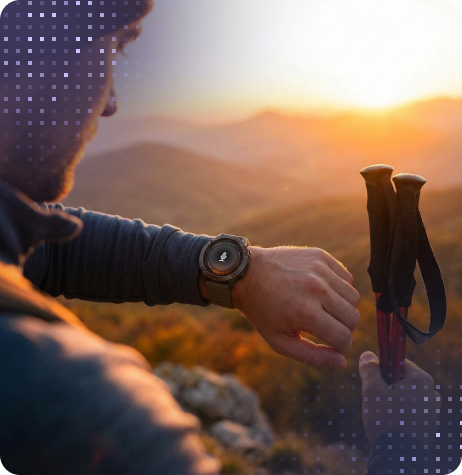







Wearables, hearables, and smart glasses operate under constant motion, limited battery capacity, background noise, and inconsistent connectivity. Sensory brings voice control, speech recognition, sound identification, and biometric security directly onto these devices, so core interactions remain fast, private, and always available. As The Verge senior reviewer Victoria Song notes, AI‑first screenless wearables “live or die by their ease of use” — Sensory’s on-device AI is designed to keep those interactions effortless.
By processing audio locally and sending only lightweight text to the cloud when needed, Sensory enables hybrid AI experiences that dramatically reduce bandwidth and power usage. This makes advanced cloud-based services, like LLMs, usable even over low-bandwidth connections such as Bluetooth or telephony, not just Wi-Fi. The result is reliable, responsive interaction without sacrificing battery life or user privacy.

Designed for ultra-low power hardware with smart on-device and cloud cooperation
Always-on wake words optimized for minimal power draw in noisy, mobile environments.
Fast, accurate speech-to-text that works offline and produces compact text output for cloud services.
Detect critical environmental sounds like alarms, alerts, and safety signals directly on the device.
Voice and face verification that ensures devices respond only to the person wearing them.
Local audio processing with optional text-based cloud interaction—orders of magnitude smaller than streaming voice.
Embedded AI that fits naturally into small, mobile form factors.
Always-on intelligence that fits within tight battery and thermal budgets.
Sending text instead of audio dramatically reduces bandwidth and enables cloud AI over Bluetooth or cellular links.
Reliable performance despite movement, wind, crowds, and unpredictable sound conditions.
Voice, sound, and biometric data stay local unless explicitly converted to text.
Optimized for embedded processors commonly used in earbuds, wearables, and smart glasses.
Practical use cases that benefit from always-available, on-device AI.


See how leading brands use Sensory’s on-device AI to deliver faster, safer, and more intuitive user experiences at scale.

“Sensory’s technology has exceeded our high standards for accuracy, speed, and efficiency. By enabling hands-free control of key functions through voice commands, we’re boosting productivity and streamlining workflows for retail staff. This allows our frontline workers to focus on what matters most – delivering exceptional customer service.”

“By combining MediaTek’s expertise in generative AI technology with Sensory’s strengths in on-device voice AI, the collective efforts of our companies enable significant strides in providing next-level entertainment and security in vehicles powered by MediaTek Dimensity Auto.”

“Sensory’s TrulyHandsfree technology is a key component in making the Piqo not just compact and powerful, but also incredibly user-friendly. This partnership enhances our ability to provide unmatched value and safety to our customers.”

“The smartest TV ever deserves the smartest approach to privacy. With Telly’s use of Sensory’s on-device speech-to-text and voice technologies, we are able to bring extremely fast, low-latency voice commands to the living room.”

“Zoom is passionate about making collaboration easier, but we always put our customer’s privacy and security front and center. Sensory’s technology checked all the boxes for us: accurate, fast and private…”
Interact with real-time AI demos and find out what sets us apart.
Everything You Need to Know
Yes. Core voice, sound, and biometric processing runs entirely on-device.
Sensory converts speech to text locally, sending only lightweight text to the cloud, which uses far less bandwidth than audio.
Absolutely. Sensory models are designed for minimal power and memory usage and are TFLite/LiteRT compatible.
Yes. Sensory is engineered for real-world wearable conditions with motion and background noise.
No. Devices work offline and can optionally connect to cloud services when available.


