
Built for every industry. Trusted by global brands bringing privacy, performance, and intelligence to the edge.
Contact Us

A serial entrepreneur with an IPO, an acquisition, 50+ patents, and a lifetime in audio-tech innovation. Todd has deep experience licensing and working with the largest tech companies in the world, including Amazon, Apple, Google, Microsoft, Samsung, and many others.
See how Sensory technology transforms user experiences — instantly, privately, and securely.


The design philosophy for intelligent hearables—earbuds, hearing aids, and smart glasses—is undergoing a critical re-evaluation. While the industry remains enamored with the generative capabilities of Large Language Models (LLMs), a cloud-only approach is hitting a wall of high operational costs, mounting privacy concerns, and lack of availability or bandwidth.
The future belongs to a Hybrid AI architecture: a model that leverages the massive reasoning of the cloud for complex queries while anchoring the user experience in robust, high-performance on-device intelligence.
The Privacy and Bandwidth Mandate: STT at the Edge
A hybrid model is only as strong as its local foundation. The first step in a privacy-first AI stack is moving Speech-to-Text (STT) entirely onto the device.
Power-Aware Intelligence: Below-the-OS Wake Words and NPUs
For hearables, battery usage is the ultimate constraint. A hybrid system must be “always-ready” without being an “always-drain” on battery life or heating up the face. This is achieved through a tiered processing hierarchy:
Domain-Specific SLMs: Always Available, Total Privacy
The most effective hybrid systems utilize on-device Small Language Models (SLMs) for immediate, domain-specific tasks. While an LLM in the cloud handles open-ended questions, a local SLM (often as small as 2.7MB to 13MB) handles core device controls, navigation, and biometric tracking.
By using domain adaptation, these small models can match or exceed the accuracy of massive cloud models for specific vocabularies—such as medical terminology or automotive commands—while maintaining privacy and avoiding any recurring cloud fees.
The Economic Shift: From OpEx to BOM
For OEMs, the move toward hybrid AI is a fiscal necessity. Relying solely on cloud APIs incurs massive, recurring operational expenses (OpEx) that scale with every user interaction.
Shifting the compute burden to the device’s silicon (the NPU) allows manufacturers to trade unpredictable recurring costs for a one-time hardware Bill of Materials (BOM) increase. This creates a more sustainable business model and allows for the deployment of truly “always-available” assistants that don’t go dark when a subscription lapses or a server goes down.
Conclusion: The Gatekeeper at the Edge
The next generation of hearables will not be defined by how much data they send to the cloud, but by how much intelligence they keep on-device. By utilizing NPUs for local STT and deploying domain-specific SLMs, the hybrid assistant becomes faster, more private, and significantly more reliable, serving as a powerful, silent gatekeeper that ensures the cloud is only called when absolutely necessary.
Watches, glasses, pins and pendants are getting smarter and smaller at the same time. With little or...
 Todd Mozer
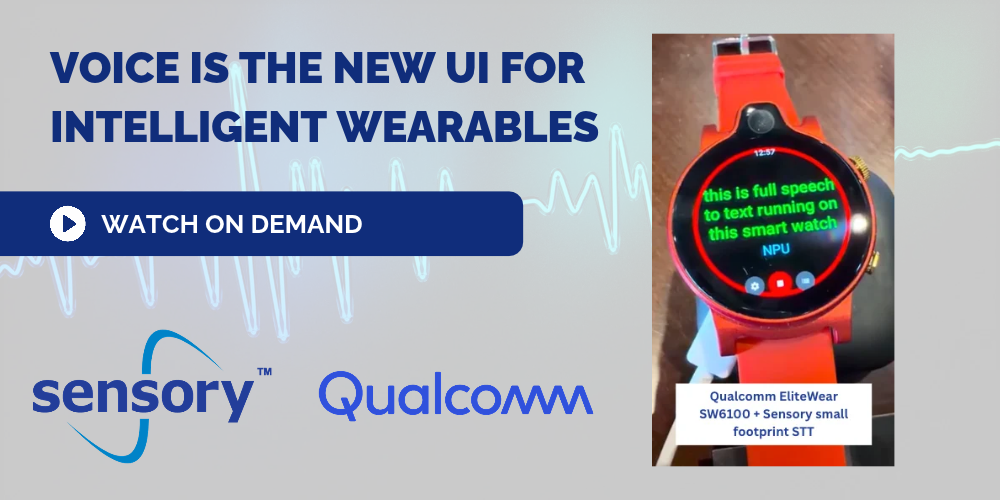
Smartwatches and smart glasses are forcing a simple truth: on a 40mm screen, voice is not a nice-to-have....
 Todd Mozer
Wearables have a fundamental challenge: batteries have finite power and require careful resource management...


