
Built for every industry. Trusted by global brands bringing privacy, performance, and intelligence to the edge.
Contact Us

A serial entrepreneur with an IPO, an acquisition, 50+ patents, and a lifetime in audio-tech innovation. Todd has deep experience licensing and working with the largest tech companies in the world, including Amazon, Apple, Google, Microsoft, Samsung, and many others.
See how Sensory technology transforms user experiences — instantly, privately, and securely.


Smartwatches and smart glasses are forcing a simple truth: on a 40mm screen, voice is not a nice-to-have. It is the only interface that can scale without adding friction, lag, or constant tapping. Sensory helps consumer electronics teams bring fast, private, always-available voice, sound, and biometric AI directly onto the device.
Wearables operate in one of the toughest product environments for consumer tech: in constant motion, limited battery resources, background noise, and unreliable connectivity. That is why the best smartwatch voice assistant experiences are built on-device, where latency stays low, data stays local, and the user experience does not depend on a network round trip.
The “fat finger” problem is real on watches and glasses. Tiny screens make menus slow, error-prone, and frustrating, especially when the user is walking, commuting, exercising, or wearing gloves. Voice turns a multi-tap task into a single micro-interaction.
That matters for the most common wearable activities:
For product teams, the goal is not just “voice support.” It is a reliable and accurate interaction model that feels faster than typing, even when the device has minimal screen space and tight thermal constraints. Sensory’s wearable solutions are designed around that reality.
Wearable OEMs and CE product teams usually evaluate voice in four ways: accuracy, latency, privacy and cost. Cloud-only stacks often struggle on all four measures because they are typically general instead of domain specific, and add network dependency, bandwidth usage, and a visible delay between user intent and device response. Sensory’s on-device approach keeps processing local, which improves responsiveness and avoids sending raw audio to the cloud unless you explicitly choose a text-based handoff.
That matters for experience design too. When the device can wake instantly, transcribe locally, and respond with TTS or haptics, the interaction feels native instead of bolted on. For smartwatches and glasses, that difference is often the line between “occasional feature” and “daily habit.”
A strong wearable voice stack is usually more than speech recognition alone. It combines wake word detection, speech-to-text, natural language understanding, and the right feedback layer for the form factor. Sensory supports this full stack with custom wake words, embedded STT tuned to the specific application domain, multiple NLU options, and biometric technologies that can further personalize or secure the user interactions with the device.
A practical architecture for wearables looks like this:
This approach is especially useful when you want voice-first app launchers for watches or fast command control without forcing users into a full conversational assistant every time. Sensory’s embedded voice AI is designed for exactly that kind of constrained, high-frequency interaction.
For smartwatch voice assistant designs, the best use cases are the ones that reduce screen dependence rather than mimic phone behavior. Common patterns include messaging, quick replies, fitness controls, timer and alarm actions, calendar updates, and device settings control. Sensory’s embedded speech-to-text is built for low-power devices and supports over 38 languages, making it a strong fit for global wearable products.
Typical product wins include:
If your roadmap includes “reply to WhatsApp on a watch using voice” or similar messaging flows, the critical design question is not whether voice can do it. It is whether the stack can do it fast enough, privately enough, and with enough accuracy to feel dependable every time.
Smart glasses raise the bar because they demand nearly seamless interactions. Users do not want to stop and scroll; they want brief, natural commands that work while they move. Sensory’s wearables page specifically highlights on-device voice, sound awareness, and biometric intelligence for compact devices that must stay efficient and responsive to the primary user.
That makes glass use cases especially strong for:
For this category, every millisecond and every milliwatt matters. On-device processing helps preserve battery life, maintain privacy, and keep experiences usable even when connectivity is weak or intermittent.
Wearables are highly personal devices, which makes recognizing the user identity and context especially important. Sensory’s voice biometrics and sound ID can help devices respond only to the right person and detect important ambient sounds locally on the device. That opens the door to more secure and more helpful wearable experiences without sending audio off-device.
Useful applications include:
Because these models run on-device, they reduce exposure of raw biometric or audio data. For consumer electronics teams, that is a practical way to meet privacy expectations while still adding intelligence.
Cloud-only voice can look simpler at prototype stage, but it gets expensive in production and requires a consumer subscription model to match cloud processing expenses with a revenue source. It introduces latency, increases bandwidth consumption, and creates dependency on stable connectivity. Sensory’s embedded stack is sold as an up front license that requires no ongoing fees because it is built to avoid those tradeoffs by keeping core speech, wake word, sound, and biometric processing local.
The business case is straightforward:
For wearable OEMs, that combination is hard to beat. It is also why embedded voice AI is becoming the default choice for products where always-on behavior and battery efficiency matter.
Sensory brings together wake words, speech recognition, sound identification, and biometric security in a way that fits compact consumer devices. The wearables solution is purpose-built for device makers that need low-power, low-latency voice interaction without sacrificing privacy or control.
If you are planning a smartwatch voice assistant, a voice-first wearable launcher, or smart glasses that need fast local AI, Sensory can help you design the interaction around the hardware instead of forcing the hardware to compensate for the software.
If your product team is evaluating smartwatch or smart glasses voice features, Sensory can help you move from concept to production with an on-device stack built for privacy, latency, and battery efficiency.
Book a demo to see how Sensory’s smart watch voice technology can support wake words, dictation, app control, sound ID, and biometric security. Or watch our smartwatch demo video here.
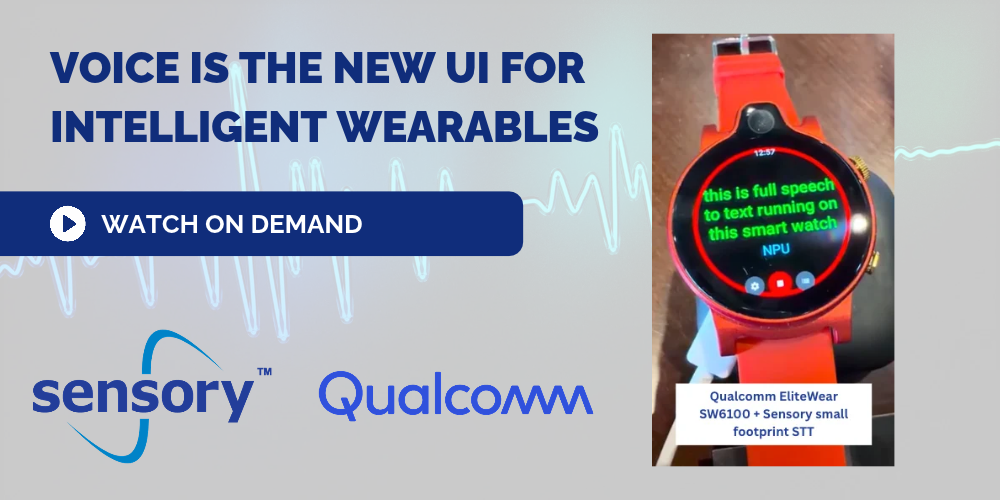
Watches, glasses, pins and pendants are getting smarter and smaller at the same time. With little or...
 Todd Mozer
The design philosophy for intelligent hearables—earbuds, hearing aids, and smart glasses—is undergoing...
 Todd Mozer
Wearables have a fundamental challenge: batteries have finite power and require careful resource management...


