
Built for every industry. Trusted by global brands bringing privacy, performance, and intelligence to the edge.
Contact Us
See how Sensory technology transforms user experiences — instantly, privately, and securely.


Watches, glasses, pins and pendants are getting smarter and smaller at the same time. With little or no screen and no keyboard, voice becomes the way people interact with them. That only works if voice runs on the device itself.
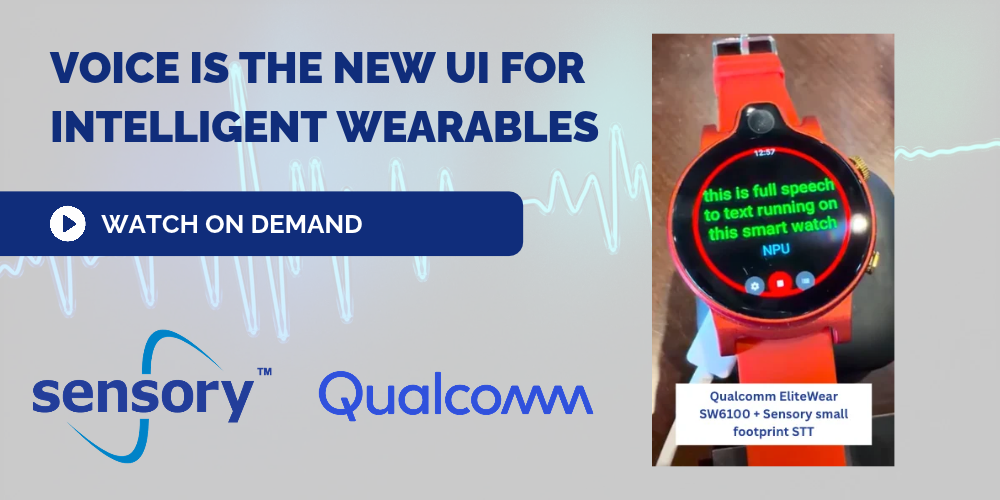
In our recent webinar, “Voice Is the New UI for Intelligent Wearables,” Sensory and Qualcomm showed what that looks like in practice, with a live demo of Sensory wake words and speech-to-text running entirely on a smartwatch built on the Snapdragon Wear Elite platform. Speakers:
Rogers opened with a look at how far on-device voice has come, and how long Sensory and Qualcomm have been building it together. Sensory started in 1994 as a chip company. Its first chip had 2K of SRAM and 64K of ROM. When Bluetooth headsets arrived, Sensory saw a product with too many buttons, beeps and blinking lights, and a perfect home for a voice interface. Sensory worked with CSR, now part of Qualcomm, to bring its wake words and phrase-spotted commands to headsets, and later to smart speakers and mobile accessories. Sensory technology has since shipped in more than 2 billion devices.
Today, Sensory’s wake words, speaker verification and phrase-spotted commands run on Qualcomm’s QCC Bluetooth line. Speech-to-text took a longer road. It moved from the cloud, to GPUs, to CPUs, to an early smartwatch demo that worked but couldn’t keep up with natural speech. Snapdragon Wear Elite closed that gap. “The combination of these two technologies is quite magical,” Rogers said.
Pramodkumar explained Qualcomm’s view of an agent-centric future, where a personal AI agent works across all of your devices. In that future, wearables play a special role because they are always with you and can gather context continuously.
As wearables get smaller and work more independently of the phone, screen space shrinks or disappears entirely. Voice becomes the primary way to interact. Pramodkumar was clear about what it takes: voice works only if it is natural, responsive, accurate, private and available without a phone or internet connection. He added that accurate transcription is critical for agentic AI, because voice is how a wearable learns what you actually want.
Announced at Mobile World Congress 2026, Snapdragon Wear Elite combines three innovations: power-efficient compute with a low-power island, on-device AI through a Hexagon NPU (with the same architecture as Qualcomm’s mobile and PC chips) plus an ultra-efficient eNPU, and a broad connectivity suite.
For voice, the platform lets each task run on the compute best suited to it. Sensory’s wake word runs at ultra-low power on the eNPU, and speech-to-text runs on the NPU only when the user starts speaking. As Pramodkumar put it, the wake word is “a very critical gate” that keeps the main processor asleep until it’s needed, which protects battery life.
On that single chip, Sensory can run always-on wake words, full speech-to-text, voice biometrics (both text-dependent and text-independent) and SoundID, which recognizes sounds like a cough, snore, doorbell, glass break or running water. Rogers noted that these technologies used to require powerful application processors and much more memory.
Rogers described two kinds of speech-to-text models: a general model with broad vocabulary for dictation and assistants, and domain-specific models tuned to what people actually say to a watch or fitness device. When a user says something outside the domain, the device can recognize that and send it to the cloud. Everything else stays local.
That matters for three reasons. Every trip to the cloud costs money, and those costs climb fast when a product succeeds. Privacy is a growing concern for users. And connections drop, especially when you’re moving. Rogers also shared benchmarks comparing Sensory’s 200 MB and 10 MB speech-to-text models against Google Cloud speech-to-text, Google’s embedded recognizer and Whisper Base, including in noise as heavy as 5 dB, with Sensory’s models performing strongly in each comparison.
Then came the moment everyone was waiting for. Using a Wear Elite smartwatch built by Qualcomm, Rogers spoke commands like “start a 45-minute outdoor cycling workout and track my heart rate” and “play my top workout playlist and increase the volume to 80%,” and the text appeared on the watch as fast as he could talk.
When an attendee asked whether the watch was connected to the internet, Rogers was glad to answer: “It’s running 100% on that watch… There’s no internet connected, there’s no phone connected.”
The audience kept the questions coming, and several answers are worth sharing:
The final question asked what sets Sensory and Qualcomm apart, since many chips can run speech-to-text. Rogers pointed to full, natural-language speech-to-text instead of rigid grammars, combined with NLU and decades of experience helping customers ship voice products. Pramodkumar highlighted the engineering partnership, saying Sensory’s team “knew their way around our platform,” which lowers the engineering lift for customers.
The takeaway was clear: on wearables, voice is no longer an extra feature. It’s the interface, and it works best when it runs on the device. With Snapdragon Wear Elite and Sensory’s on-device voice stack, natural, private, always-available voice is ready for watches, glasses, pins and whatever personal AI device comes next.
What to do next:
 Todd Mozer
Smartwatches and smart glasses are forcing a simple truth: on a 40mm screen, voice is not a nice-to-have....
 Todd Mozer
The design philosophy for intelligent hearables—earbuds, hearing aids, and smart glasses—is undergoing...
 Todd Mozer
Wearables have a fundamental challenge: batteries have finite power and require careful resource management...


